 TheOneToGo
Split With Kids: Roman Ruins, Shallow Water, and a Few Hard Edges
Split works well with kids if you treat it as a compact old-city-and-sea trip, not a resort holiday. The best bits are close together. The hard parts are heat, steps, polished stone, and summer crowds.

Split is more fun with kids than it looks on paper. Diocletian's Palace is not a sealed museum. It is a lived-in maze of lanes, courtyards, cats, laundry, ice cream counters, and Roman leftovers. Children do not need a long lecture here. They need a short story, a cold drink, and permission to poke around for half an hour at a time.
The catch is that Split is not gentle in July or August. The old town gets hot, the stone can be slick, and strollers are awkward inside the palace lanes. Base the day around early starts, beach breaks, and short outings. I would pick Split over Dubrovnik with younger kids because it is flatter, less managed, and easier to escape when everyone gets tired.
-
Do Diocletian's Palace as a scavenger hunt, not a tour
Best early morning or after dinner. Keep it short.The palace is the best family sight in Split because it does not feel like one sight. Go early, give kids simple targets, find a sphinx, a gate, a column, a tiny alley, a courtyard with music, then leave before the adult history talk drags the mood down. The whole area is uneven and busy, so this is better for walkers than for a sleepy toddler in a stroller.
Do Diocletian's Palace as a scavenger hunt, not a tour guide
-
Use the Substructures for shade and drama
Good heat escape. Check current opening times and ticket rules before promising anything.The palace substructures are one of the few historic stops in Split that can hold a child's attention without much explaining. The ticketed halls are cool, echoey, slightly spooky, and easy to grasp: this is the underside of a Roman emperor's palace. I would do this before the cathedral tower with younger kids, because it asks less of their legs and gives more back.
Use the Substructures for shade and drama guide
-
Let Bačvice be your easy beach, not your perfect beach
Go in the morning. Bring shade if you need it.Bačvice is close, sandy by Croatian standards, and shallow enough for little kids to splash without the usual pebble-beach argument. It is also crowded, loud, and not especially pretty when you compare it with the coves around Marjan or the islands. Use it for a quick swim, a sandy reset, and watching locals play picigin in the shallows. Do not build your whole beach fantasy around it.
Let Bačvice be your easy beach, not your perfect beach guide
-
Take Marjan slowly, or take the bus toward Bene
Best for active kids. Avoid the hottest part of the day.Marjan is where Split starts to feel breathable again. There are pine paths, viewpoints, beaches, and enough space for kids to move without scraping past tour groups. The climb can be more work than parents expect, especially in heat, so do not sell it as a casual stroll unless your kids like hills. Promet line 12 runs between Sv. Frane and Bene, which can save everyone's legs, though it does not take you to the top of the hill.
Take Marjan slowly, or take the bus toward Bene guide
-
Use the Riva as your low-effort evening plan
Good final hour of the day, especially with tired children.The Riva is not a deep cultural experience, and that is exactly why it helps. After dinner, kids can wander, watch boats, eat ice cream, and burn off the last of the day without another formal stop. It is crowded in summer, but it is flat, central, and easy to leave from. I would rather do the Riva at dusk than force one more museum.
Use the Riva as your low-effort evening plan guide
-
Make one easy day trip, preferably Klis or Trogir
Do not cram both into a tired family day unless your kids travel well.If you have more than two full days, leave Split once. Klis Fortress is the better pick for castle-minded kids, with big views and enough ruined-wall energy to make the climb feel worth it. Promet lists buses from Split to Klis, and schedules change, so check the current line before you go. Trogir is prettier and easier by public transport, with Promet line 37 running Split, the airport, and Trogir, but it is another stone old town, so it can feel repetitive after Split. Choose Klis for action, Trogir for a gentler wander.
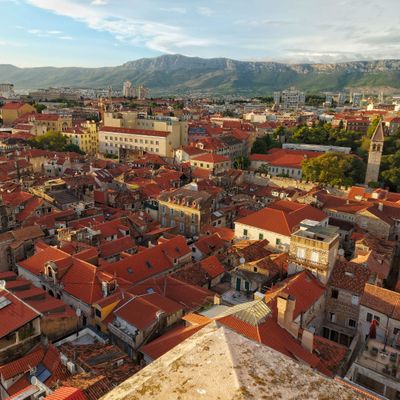
Photo credits
Photos: Dennis G. Jarvis (CC BY-SA 2.0); Ballota (CC BY-SA 3.0); Dedinski89, Tatyana Peshkova (CC BY-SA 4.0); dronepicr (CC BY 2.0) via Wikimedia Commons.
Split is a strong family city for three or four days, especially with school-age kids. It has history that does not require silence, beaches close enough for emergency resets, and a waterfront that makes evenings easy. I would not choose it as a full week with toddlers in peak summer unless you have an apartment, a flexible routine, and a high tolerance for heat. Ferries can make island day trips possible in season, but they add schedule pressure. For most families, the better rhythm is old town in the morning, water in the afternoon, Riva or Marjan at dusk.
Split With Kids: Roman Ruins, Shallow Water, and a Few Hard Edges: FAQs
Yes, but it is not effortless. The palace lanes have steps, crowds, slick stone, and awkward stroller moments. A carrier is useful, and a stay close to the old town or Bačvice will make the trip much easier.
Three days is the best fit for most families: one for the palace and Riva, one for Marjan or beaches, and one for a day trip or slow repeat of whatever worked. Two days is fine but tighter. A full week needs island trips, nearby towns, or a very beach-heavy plan.
Bačvice is the easiest because it is central, sandy, and shallow. It is also busy and not the calmest choice. For a better setting, look toward the Marjan side, but expect more walking, pebbles, or bus planning.
Not necessarily. A short family-focused guide can help if your kids like stories, but a long standard tour is a gamble. The palace works well as a self-guided wander if you keep the goals simple and stop before everyone is done.
Explore more in Split
Plan your trip
- Best time to visit Split
- Day trips from Split
- One Day in Split: Palace Stones, Sea Air, and a Real Swim
- Two Days in Split: Palace Stones, Sea Air, and One Proper Escape
- 3 Days in Split: Palace Lanes, Marjan, and an Easy Trogir Day Trip
- Split at Night: Palace Stones, Riva Walks, and Bačvice After Dinner
- Split When It Rains: Cellars, Museums, Churches, and a Better Plan Than the Riva
- Diocletian's Palace vs Marjan Forest Park: which Split classic should you pick first
- Trogir vs Hvar: Which Day Trip from Split Is Better?
Top attractions
Worth it, or skip it?
Join the early list. When it launches, expect the occasional short email: the handful of things actually worth your time in each city, the famous ones to skip, and when it's free or cheaper to just walk in. No paid placement.